

Sustainability · 2025
In this section47 topics
- Sustainability Policy4 items
- Sustainability Goals & UN SDGs3 items
- Policy Review3 items
- Business Value Chain1 item
- Stakeholder Analysis1 item
- Environmental Policy & Guidelines5 items
- Environmental Policy Review3 items
- Energy — Plan & Guidelines2 items
- Energy — Electricity Consumption1 item
- Energy — Fuel Consumption1 item
- Energy — Targets1 item
- Energy — Performance & Outcomes2 items
- Water — Plan & Guidelines2 items
- Water — Withdrawal, Discharge & Consumption1 item
- Water — Targets1 item
- Water — Performance & Outcomes2 items
- Waste — Plan & Guidelines2 items
- Waste — Generation, Disposal & Recycling2 items
- Waste — Targets1 item
- Waste — Performance & Outcomes2 items
- GHG — Plan & Guidelines2 items
- GHG — Emissions1 item
- GHG — Emissions Verification1 item
- GHG — Principles & Standards1 item
- GHG — Targets1 item
- GHG — Performance & Outcomes1 item
- Environmental Legal Incidents1 item
- Social Policy & Guidelines4 items
- Social Policy Review3 items
- Human Rights Due Diligence2 items
- Employees — Plan & Guidelines3 items
- Employees — Workforce1 item
- Employees — Remuneration & Provident Fund1 item
- Employees — Training & Development1 item
- Employees — Occupational Health & Safety1 item
- Employees — Labour Relations1 item
- Employees — Employee Representation2 items
- Employees — Targets1 item
- Employees — Performance & Outcomes2 items
- Customers — Plan & Guidelines3 items
- Customers — Satisfaction Results1 item
- Customers — Targets1 item
- Customers — Performance & Outcomes2 items
- Community & Social — Plan & Guidelines3 items
- Community & Social — Targets1 item
- Community & Social — Performance & Outcomes2 items
- Law Violation Incidents1 item
Sustainability Policy
Has a Sustainability Policy
Yes
Policy Description
The Company prepares a sustainability report as part of its annual report (one report). The data presented covers the period from January 1, 2025, to December 31, 2025, in accordance with the reporting framework of the Sustainability Reporting Guide for Listed Companies and the ESG Metrics guidance document for the real estate and construction industry group of the Stock Exchange of Thailand. This is to disclose the Company's corporate governance, economic, environmental, and social performance to all stakeholders, and the reporting scope covers the operations and activities of the head office.
The Company has developed a Sustainable Business Driving Policy, which, in summary, states that the Company is committed to becoming a leading construction contractor in the country, capable of sustainable growth under good corporate governance principles that continue to prioritize responsibility towards society, communities, the environment, and all stakeholders.
The Company recognizes and prioritizes engagement with stakeholders, believing that good relationships and trust will contribute to achieving its goal of becoming an organization that develops and grows sustainably. The Company has categorized stakeholders based on the level of impact from the Company's operations and the level of influence of stakeholder groups on business operations, resulting in the following stakeholder groups:
1. Customers
2. Employees
3. Business Partners
4. Shareholders and Investors
5. Surrounding Communities
6. Competitors
7. Financial Institutions
8. Government Agencies
Assessment of Material Sustainability Issues : The Company considers organizational sustainability issues using both internal and external data, combined with the Company's vision, mission, activities, value chain, as well as the risks and opportunities of sustainability issues affecting business operations, benchmarked against sustainability issues from companies in the same industry both nationally and globally, including industry-specific sustainability standards and indices such as The Sustainability Accounting Standards Board (SASB), Morgan Stanley Capital International (MSCI), and corporate sustainability assessments (S&P Global). Subsequently, the Company's working group and representatives from each department identify sustainability issues relevant to the Company through analysis and consideration of positive and negative impacts that have occurred or may occur to stakeholders based on their expectations. Once topics are identified, they are prioritized and presented to management for approval before establishing management guidelines to mitigate the negative impacts of each issue and respond to stakeholder expectations regarding the organization's material sustainability issues.
1. Customer Satisfaction G
2. Occupational Health, Safety, and Well-being S
3. Good Corporate Governance and Business Ethics G
4. Supply Chain Management G
5. Fair Treatment of Labor S
6. Environmental Management E
7. Community Engagement S
8. Human Resource Management S
9. Respect for Human Rights S
10. Efficient Resource Utilization G
11. Data Security and Safety G
12. Climate Change Management E
13. Waste Management E
14. Business Innovation Development G
3.1 Sustainability Management Policies and Goals : The Company recognizes that good financial performance alone cannot ensure sustainable organizational growth. Therefore, the Company emphasizes adherence to good governance principles, business ethics, and a code of conduct that fairly considers the impact on all stakeholders under its responsibility towards society, communities, and the environment. These serve as strong pillars for sustainable organizational growth. The Board of Directors' Meeting No. 5/2022, held on November 11, 2022, resolved to approve the Sustainable Business Driving Policy, replacing the Social Responsibility Policy. Subsequently, in early 2023, the Company participated in the Sustainability Data Quality Development Project for listed companies of the Stock Exchange of Thailand to enable the Company's personnel to understand various contexts of sustainability and to adopt operating methods consistent with the Stock Exchange of Thailand's sustainability management guidelines. Following this, the Board of Directors' Meeting No. 4/2023, held on November 10, 2023, resolved to approve amendments to the Sustainable Business Driving Policy, including additional organizational sustainability objectives and targets aligned with the assessed sustainability issues. This is to inform the Company's personnel and stakeholders that the Company will operate under good governance, continuing to prioritize responsibility towards society, communities, and the environment, as well as human rights principles, and maintaining importance for all stakeholders, which aligns with the United Nations' Sustainable Development Goals (SDGs). The Board of Directors' Meeting will review this policy annually. Shareholders can study the full Sustainable Business Driving Policy at https://investor.tekacon.com/th/corporate-governance/corporate-governance-policy
Organizational Sustainability Management Approach: To drive all relevant departments to comply with the Sustainable Business Driving Policy for 2023, the Company appointed a Sustainability Data Quality Development Project Working Group, comprising department managers, section managers, and relevant line executives. This group receives one-on-one in-depth consultations from experts on managing and analyzing sustainability issues to suit the business context. For sustainability operations, the Company has developed a sustainability action plan and assigned relevant employees to participate in sustainability activities through meetings, training, and direct assignment of sustainability duties to relevant departments. Those involved will integrate sustainability principles into their work processes. After the completion of this project, the Company established a new Sustainability Working Group consisting of relevant executives, who review performance before submitting it to the Executive Meeting, the Risk and Sustainability Management Committee Meeting, and the Board of Directors' Meeting.
Governance and Economic Dimension: The Company places importance on good corporate governance alongside strong business performance, promoting responsible operations throughout the value chain. The Company has established corporate governance policies, business ethics and code of conduct, and other related policies to serve as a framework and guideline for the Company's personnel to operate correctly and to inform stakeholders. The Company also raises awareness about good corporate governance among its personnel. Furthermore, it supports various factors that enable employees to adapt to changes, and ensures complete, transparent, and timely disclosure of information and operational results so that all stakeholders are equally informed. The corporate governance and economic dimensions of the Company include the following issues: 1. Good Corporate Governance and Business Ethics (details specified in Part 2 Corporate Governance) 2. Supply Chain Management 3. Customer Satisfaction 4. Data Security and Safety, and 5. Business Innovation Development (details specified in Part 1, Item 1 Operational Structure).
Data Security and Safety Issues: The Company recognizes the importance of maintaining information security in its operations because it currently uses various data, including personal data, through information technology systems. Therefore, the Company has established an information technology security policy and guidelines to ensure that information technology systems have good internal controls, are secure, accurate, reliable, and can operate continuously. This also sets standards, guidelines, and operating procedures for users, including external parties working for the Company, to be aware of and comply with. The Company has systems in place to prevent its information or data from being intruded upon, altered, stolen, destroyed, or subjected to any other actions that could harm the Company due to improper use or threats from internal or external sources. Should the system ever fail or encounter any issues, the Company will resolve and collect information on those issues to improve and rectify them. The Company has also included information technology risks as a key organizational risk. Details of information technology risks are specified in Chapter 1, Risk Management. Furthermore, the Company recognizes the importance of collecting and using personal data, and has therefore established a personal data protection policy and practices that are as stringent as personal data protection laws, to serve as a guideline for relevant parties to be aware of and comply with. The Company has provided training on personal data protection and the use of information technology to all employees, and it is also included as part of new employee training to raise awareness and prevent various threats. In 2025, no cyberattacks were detected, and no personal data breaches occurred.
To raise awareness about information technology, cybersecurity, and to prevent threats, in 2025, the Company has a training program for employees, with 100% of new employees able to be trained on the following topics:
Internal organizational information technology, system usage requirements, computer network system control
Use of various devices, including prohibitions
Cybersecurity
PDPA and Internal Communication Channels
Shareholders can study the full Personal Data Protection Policy at: https://www.tekacon.com/privacy-policy/
Customer Satisfaction Issues: Customer Satisfaction Policy and Guidelines. As customer satisfaction is a crucial factor that continuously earns the Company trust for selection as a construction contractor in subsequent projects, the Company prioritizes its operations, including the protection of customer personal data. The Company has a personal data protection policy and guidelines that cover customer personal data, and this policy has been disclosed on the Company's website. Furthermore, to comply with ISO 9001:2015 quality system standards, the Company conducts customer satisfaction assessments. To ensure accurate and fair evaluation results, the task of distributing assessment forms to customers and analyzing the results is handled by the ISO quality system unit, not by supervising engineers. The assessment forms used vary according to the appropriate construction phase. The Company sets a target satisfaction score of not less than 80% for each project. If the satisfaction score falls within a range requiring improvement, the relevant department must develop and implement an improvement plan. The Company will use satisfaction scores as part of the project's performance indicators. The Company will analyze these satisfaction assessment results to develop and improve work processes to achieve maximum satisfaction and to continuously enhance quality and service, thereby elevating customer satisfaction and trust in future years. In the future, the Company plans to develop employees to ensure operations meet customer satisfaction, aiming for satisfaction scores of 80% or higher.
For the 2025 satisfaction scores, the Company received an average customer satisfaction of 72.41%. There were no complaints from customers, no customer data breaches, and no complaints regarding consumer rights violations or quality. Channels for receiving complaints are specified in Part 1, Corporate Governance, Item 5.
Furthermore, the Company has responsible marketing and advertising practices and guidelines for communicating information about the impact of products and services to customers. Starting from the pre-bidding phase, the Company communicates directly with customers, offering various beneficial construction techniques. Once the Company secures a project, during construction, if problems arise, the Company communicates directly with customers to jointly resolve issues. After project handover, the Company has a team that continues to be responsible for post-handover work throughout the warranty period.
Governance and Economic Operations Aligned with SDG Goals
Annual Business Continuity Planning (BCP) drills are conducted. Innovation in production is promoted through employee innovation contests (8).
The Company possesses an infrastructure that supports change and promotes business operations. It maintains good corporate governance by complying with relevant laws, as well as business ethics and code of conduct. It actively combats corruption and bribery in all instances and raises awareness among its personnel through training (16).
Policy Document Link
https://investor.tekacon.com/storage/document/cg/sustainable-business-development-policy-en.pdf
Page Number in Report
1
Sustainability Goals & UN SDGs
Has Sustainability Goals
Yes
Goals Description
The key operational issues for 2023 – 2026 are the top 4, which include: •
1. Customer Satisfaction: The company assesses satisfaction across three aspects: quality, time, and safety. The assessment forms vary according to the construction progress. The company sets a target for construction sites to achieve a customer satisfaction score of no less than 80%. The operational results for 2025 the company achieving an average satisfaction score of 72.41.%.
2. Occupational Health, Safety, and Well-being: Although the widespread dust problem currently stems from multiple causes, it is undeniable that construction sites are one contributing factor. The company is not complacent and is committed to addressing issues within its control by installing dust detection equipment at construction sites. When dust levels exceed standards, the equipment immediately alerts employees to implement dust reduction measures. The measures adopted by the company include a water spraying system around the construction site to help reduce airborne particulate matter. Additionally, the company has increased the frequency of watering roads within the project to minimize dust dispersion from vehicle traffic. All truck wheels are also washed before leaving the project to prevent dust from being carried onto public roads. The company continuously prioritizes dust control to mitigate impacts on communities and the environment, and is dedicated to improving the effectiveness of its measures. Furthermore, the company remains committed to reducing risks related to occupational safety by developing and implementing International Organization for Standardization requirements. In 2024, the company received ISO 45001:2015 certification for its Occupational Health and Safety Management System.
To instill a safety culture in the workplace, the company has organized various awareness-raising activities for employees, including:
Safety Award Project: This involves monthly safety assessments according to a checklist at construction sites, and Qa awards are presented to those with the highest scores.
TOSH-OHSMS:2019 Project (TOSH): To enhance the company's safety management system efficiency, including inspection, evaluation, system review, management plan review, safety improvement and development. Monitored by TOSH once a year, most recently on October 22, 2024 (no monitoring in 2025 as TOSH is reviewing and amending regulations).
5S Project: (Sort, Set in Order, Shine, Standardize, Sustain) To promote awareness among all employees regarding occupational health and a hygienic working environment. Training is provided to relevant personnel, followed by verification of operations against the checklist.
3. Good Corporate Governance and Business Ethics: In 2025, the company aims for 100% of new permanent employees to receive training on Good Corporate Governance (CG) and sustainability, and for 100% of Provide employee training., which the company successfully achieved.
4. Supply Chain Management: To ensure comprehensive sustainability operations across the entire supply chain, the company has established a code of business conduct for partners. This is to communicate to key partners how the company expects them to operate in terms of ESG. The company set a target for 100% of key partners commencing transactions in 2025 to sign an acknowledgment of the code of conduct, and the results showed that...
- Key construction material and equipment partners commencing transactions in 2025 have signed an acknowledgment of the code of conduct, achieving 100%.
- Key contractor partners commencing transactions in 2025 signed an acknowledgment of the code of conduct 100%.
2025 Targets
Waste Targets: The head office and branches can sort waste by type and send it directly to waste recycling plants, achieving targets.
Water Targets : The head office and branches aim to reduce water consumption by 2% compared to the previous year. Construction sites have built water filters from on-site materials, achieving targets.
Energy Targets: Reduce energy consumption and switch to clean energy, such as company vehicles and solar power, achieving targets.
Greenhouse Gas Targets: Consultants are arranged to provide knowledge on carbon capture and emissions, achieving targets.
UN Sustainable Development Goals
| SDG Goal |
|---|
| Goal 1 No Poverty |
| Goal 1 No Poverty |
| Goal 3 Good Health and Well-being |
| Goal 3 Good Health and Well-being |
| Goal 4 Quality Education |
| Goal 4 Quality Education |
| Goal 5 Gender Equality |
| Goal 5 Gender Equality |
| Goal 6 Clean Water and Sanitation |
| Goal 6 Clean Water and Sanitation |
| Goal 7 Affordable and Clean Energy |
| Goal 7 Affordable and Clean Energy |
| Goal 8 Decent Work and Economic Growth |
| Goal 8 Decent Work and Economic Growth |
| Goal 9 Industry, Innovation and Infrastructure |
| Goal 9 Industry, Innovation and Infrastructure |
| Goal 10 Reduce Inequalities |
| Goal 10 Reduce Inequalities |
| Goal 12 Responsible Consumption and Production |
| Goal 12 Responsible Consumption and Production |
| Goal 13 Climate Action |
| Goal 13 Climate Action |
| Goal 16 Peace, Justice and Strong Institutions |
| Goal 16 Peace, Justice and Strong Institutions |
Policy Review
Policy Reviewed This Year
Yes
Policy Changed This Year
Yes
Review Details
Goal achievement is explained for each sustainability issue.
Business Value Chain
Value Chain Description
The company prioritizes operations that align with its vision of being a leading construction contractor and its organizational mission to deliver quality work on time, with good management systems, and to create customer satisfaction, thereby building trust and maintaining its reputation across all activities in the company's value chain.
3.2.2 Stakeholder Analysis in the Business Value Chain
The company recognizes and prioritizes engagement with its stakeholders, believing that strong relationships and trust will contribute to achieving its goal of becoming a sustainably developing and growing organization. The company has reviewed and prioritized stakeholders based on the criteria of the impact level from the company's operations and the influence level of stakeholder groups on business operations, resulting in the following stakeholder groups:
1. Customers
2. Employees
3. Partners
4. Shareholders and Investors
5. Surrounding Communities
6. Competitors
7. Financial Institutions
8. Government Agencies
The company has internal departments responsible for each activity in the business value chain, such as the accounting and finance department that liaises with the Revenue Department and various banks, the community relations department that coordinates with communities around the construction site to listen, communicate, and respond to potential community needs, and the investor relations department that provides information, listens to, or answers questions from investors, among others. These internal departments will listen to the needs of the stakeholders they coordinate with and then discuss them with management to establish approaches for responding to the potential needs of those stakeholders.
Supply Chain Management Policy and Plan: The company manages its supply chain under good governance, maintaining a focus on social and environmental responsibility, with flexibility to adapt to changing factors, so that all stakeholders in the supply chain can grow together sustainably. Therefore, a supply chain management policy has been established to serve as an operational framework and a guideline for efficient procurement processes. In 2023, a business code of conduct for partners was introduced. In subsequent years, the company will require new partners to sign and acknowledge this code of conduct. Furthermore, the company has revised its procurement manual and partner evaluation form to align with the sustainability operational framework and will communicate these changes to key partners.
The company has established a process for selecting and evaluating partners before procurement or engagement to ensure fair competition in the procurement process and prevent monopolization by any single partner. The company selects and evaluates the quality of all partners by maintaining a Subcontractor list, categorized by the subcontractors' expertise, and a Supplier list, categorized by product type. The partner registers include details on product quality or work quality, delivery, punctuality, and service. Subsequently, all partners are evaluated quarterly. If any partner receives a low score, the company will send a letter notifying them to improve in the areas with low scores; however, if no improvement is made, the company will remove their name from the partner register. Furthermore, the company has implemented an Enterprise Resource Planning (ERP) system to manage the procurement process, which helps in planning and managing procurement processes more efficiently and with higher quality.
3.2.1.1 Primary Activities in the Value Chain
(1) Marketing and Sales:
Stakeholders, Customers, Competitors, Employees
Job Procurement and Bidding: As the company operates in the construction contracting business, its main activities are business-to-business (B2B). This means starting with project owners who wish to construct buildings such as hospitals, school buildings, shopping centers, condominiums, etc. The company has a marketing department responsible for monitoring news regarding tender announcements, as well as instances where project owners who have previously worked with the company invite it to participate in bidding. Before deciding to participate in a bid, the company evaluates various aspects, such as its capacity to undertake the project, to ensure it can deliver quality work within the specified timeframe, assesses competitors, and evaluates the credibility of the project owner. Subsequently, the company purchases tender documents or Terms of Reference (TOR) to analyze the project design and propose a price deemed appropriate. If the bid is successful, a construction contract will be signed.
(2) Input Management or Inbound logistics
Stakeholders, Customers, Partners, Employees, Laborers, Subcontractors
Construction Preparation: The company will prepare a method statement and proceed according to the established steps, such as surveying the area before construction to lay out the construction site, planning the procurement and allocation of relevant resources, preparing temporary utilities, preparing machinery, personnel, and designs, planning procurement from the Subcontractor list which details the quality of work and expertise of subcontractors, and sourcing labor from within the country and from neighboring countries. For labor from neighboring countries or foreign workers, the company registers all workers to ensure they can work legally. All laborers are employed fairly and in accordance with Thai labor laws. If the company procures construction materials itself, it will immediately order or reserve important construction materials in advance upon receiving notification from the project owner that the company has won the tender, a Letter of Intent (LOI), or a Letter of Award (LOA), especially for rebar, which experiences significant price fluctuations compared to other construction materials. Additionally, the company regularly monitors construction material prices to assess price trends for planning appropriate material purchases, procuring from the Vendor List, and purchasing from registered vendors by comparing prices and product quality to obtain quality construction materials at suitable price levels.
(3) Operations
Stakeholders, Customers, Employees, Laborers, Subcontractors
Construction Operations: Construction will proceed according to the work procedures, with the Quality Control department conducting inspections and controlling quality during construction (QC Inspection) to ensure adherence to the designs and plans. Additionally, the quality and progress of the work will be re-inspected by the project owner or project consultant before handover. During construction, personnel will be responsible for managing safety and environmental impacts, and community relations officers will oversee neighboring communities. Throughout the construction period, satisfaction surveys regarding quality and safety will be conducted to inform further development and improvement of operations.
(4) Project Delivery or Outbound logistics
Stakeholders, Customers, Employees, Laborers, Subcontractors
Project Delivery: Upon completion of construction, the company will hand over the work to the project consultant for inspection to ensure that the construction is complete and in accordance with the contract. If there are any points requiring correction, the company will rectify them and resubmit the matter to the consultant for re-inspection. Subsequently, the consultant will forward the matter to the project owner to issue a building handover certificate to the company.
(5) After-Sales Services
Stakeholders Customers, Employees, Laborers, Subcontractors, Residents, Condominium Juristic Persons
Performance Warranty: Once the company receives the building handover certificate from the project owner, the company will issue a performance guarantee letter to the project owner. Generally, structural work is guaranteed for 5 years, while architectural and building system work is guaranteed for 2 years. For condominiums, residents will notify the company through the project's juristic person or the project owner. For other types of buildings, the building owner will notify the company to carry out repairs. The after-sales service department will contact the juristic person or project owner to schedule a repair date. Upon expiration of the performance guarantee period, the company will inform the project owner. The project owner will then inspect the work, and if any issues require correction, they will notify the company to rectify them, after which the performance guarantee letter will be returned to the company.
3.2.1.2 Support Activities
Support activities are those that enable primary activities to achieve their goals, and they are no less important than primary activities. The company operates carefully and adheres to management criteria, such as human resource management, accounting and finance, information technology, occupational health and safety, procurement, administrative units (liaising with government agencies), and community relations units that coordinate with communities around the construction site, among others.
Stakeholder Analysis
Stakeholder Analysis
| Stakeholder Type | Stakeholders | Stakeholder Expectations | Response to Expectations | Communication Activities |
|---|---|---|---|---|
| External stakeholders | 2923 · Description: Customers | Delivery of quality work on time as stipulated in the contract - Work performance is guaranteed | - Quality management based on engineering principles - Strict adherence to management and safety - A dedicated unit for supervision and inspection to ensure quality work and timely completion - Workmanship warranty - Customer satisfaction assessment | 2938 · Description: Visit · 2941 · Description: Online Communication · 2942 · Description: Internal Meeting · 2943 · Description: External Meeting · 2947 · Description: Satisfaction Survey · 2949 · Other name: On-site inspection · Description: Others |
| Internal stakeholders | 2921 · Description: Employees | - Receive fair compensation and evaluation- Have welfare benefits comparable to the same industry- Achieve career advancement and stability- Receive development in various potentials- Work in a clean and safe environment | Ensure fair employee performance evaluations and treat employees in accordance with labor laws and human rights without discrimination. Provide channels for receiving complaints. Provide employee development. Provide welfare benefits exceeding legal requirements, such as life insurance and provident funds. | 2942 · Description: Internal Meeting · 2948 · Description: Training / Seminar · 2949 · Other name: Performance Appraisal · Description: Others |
| External stakeholders | 2899 · Description: Suppliers | Ensure fair competition - Make timely payments for goods | Partner selection will be conducted fairly by comparing both price and product quality. Payment for goods will be made on schedule. | 2941 · Description: Online Communication · 2942 · Description: Internal Meeting · 2943 · Description: External Meeting · 2945 · Description: Complaint Reception · 2949 · Other name: Evaluate partners · Description: Others |
| Internal stakeholders | 2913 · Description: Shareholders | - Good corporate governance in accordance with good governance principles - Effective risk management - Growing business capable of consistently paying dividends - Accurate, complete, transparent, and timely disclosure of information - Receipt of legal rights | Transparent and auditable corporate governance. Information is disclosed transparently in accordance with relevant regulations to provide shareholders with sufficient information for decision-making. Shareholders are granted rights beyond those legally mandated. Operations adhere to good corporate governance principles and business ethics. | 2939 · Description: Press Release · 2944 · Description: Annual General Meeting (AGM) · 2949 · Other name: Opportunity Day · Description: Others · 2949 · Other name: Disclose information via the stock exchange system · Description: Others · 2949 · Other name: The provided input is a URL, not text for translation. Please provide text in Thai for translation. · Description: Others · 2949 · Other name: email: ir@tekacon.com · Description: Others · 2949 · Other name: One Report · Description: Others |
| External stakeholders | 2902 · Description: Community | - Construction minimizes impact on surrounding communities - No accidents in and around the construction site - Dust and noise pollution are prevented from disturbing the community - Feedback from residents around the construction site is considered | Conduct construction in accordance with standards and comply with the Environmental Impact Assessment (EIA) report and related measures; arrange for environmental quality monitoring to meet standards; support various activities that promote the quality of life of surrounding communities; install dust screens and sound insulation to reduce noise levels; wash vehicle wheels before exiting the construction site; provide temporary wastewater treatment tanks during construction; implement strict safety management; establish a community relations unit to coordinate with communities around the construction area; designate central staff to handle complaints. | 2940 · Description: Social Event · 2945 · Description: Complaint Reception · 2949 · Other name: Field visit to gather feedback · Description: Others · 2949 · Other name: Community relations officers are available to manage the communities surrounding the work site. · Description: Others |
| External stakeholders | 2898 · Description: Competitors | - The competition is fair | Adherence to ethics and business conduct | 2945 · Description: Complaint Reception · 2949 · Other name: The provided input is a URL, not text for translation. Please provide text in Thai for translation. · Description: Others |
| External stakeholders | 2925 · Description: Financial institution | The company has achieved favorable operating results. The bank is able to offer other banking products to the company, such as Bills of Exchange, investment funds, and other financial instruments. | Achieved good operating results - Consider selecting other products as appropriate for liquidity management | 2938 · Description: Visit · 2942 · Description: Internal Meeting · 2949 · Other name: Telephone and email of the relevant department · Description: Others |
| External stakeholders | 2931 · Description: Government agencies and Regulators | Compliance with relevant laws - Cooperation | Study relevant laws. If there are any legal ambiguities, the responsible party will immediately consult with the relevant government agency. Comply with relevant laws. Cooperate with government agencies. | 2941 · Description: Online Communication |
Environmental Policy & Guidelines
Has an Environmental Policy
No
Policy Description
The company has a sustainable business drive policy that encompasses environmental aspects. Therefore, the company does not have a specific environmental policy. The summarized content and environmental guidelines state that the company will comply with laws related to environmental conservation, recognizing the importance of reducing environmental impacts from business operations, such as minimizing waste generation by adhering to the principle of 'reduce or use only what is necessary' and reusing materials multiple times to efficiently circulate shared resources. This also includes allocating resources and energy efficiently and considering climate change management.
Environmental Management Issues : The company prioritizes environmental conservation, with environmental management being a key component of its sustainable business drive policy. Furthermore, the company has a safety, occupational health, and environmental policy, including environmental guidelines, to serve as a framework for environmental management and to prevent potential environmental impacts throughout the value chain. The company will ensure that its operations comply with laws related to environmental conservation and the requirements specified in the Environmental Impact Assessment (EIA) reports for each project, covering energy management, water management, air pollution control, and waste management. The company has personnel responsible for environmental management, as well as environmental risk management, environmental impact reduction, and continuous review and improvement of environmental performance. Employees are instilled with an environmentally conscious mindset, focusing on caring for and developing service processes and selecting materials and products that are friendly to nature and the environment. Additionally, the company emphasizes reducing waste generation by adhering to the principle of 'reduce or use only what is necessary' with the objective of maximizing the efficient circulation of shared resources, avoiding environmental destruction by using non-consumable and reusable materials.
Furthermore, the company has established environmental management guidelines consistent with its business operations, such as economical electricity usage, replacing end-of-life gasoline vehicles with electric vehicles, switching to automatic walkway lighting systems that activate only when people pass by, utilizing clean energy alternatives, using sensor-activated faucets for water conservation, and 100% wastewater treatment at the head office before discharge into water sources. The company aims to ensure its personnel have a comprehensive understanding of carbon footprints, from methods of collecting carbon footprint data to using this information to plan and manage the reduction of greenhouse gas emissions and address climate change. The goal is to provide consultants to educate and raise awareness about carbon footprints, with the company aiming to achieve its set targets by 2025.
Environmental Dimension : The company complies with laws related to environmental conservation, recognizing the importance of reducing environmental impacts from business operations. This includes allocating resources and energy efficiently and considering climate change management to ensure effective environmental management and minimize environmental impact. The head office and branches will comply with relevant laws. For each project, relevant laws will be followed, and if any project requires an Environmental Impact Assessment (EIA) report, the measures specified in the report will also be implemented. The company's environmental dimensions comprise: 1. Environmental Management, 2. Efficient Resource Utilization, 3. Waste Management, and 4. Climate Change Management.
Environmental operations aligned with SDGs targets
- Providing hygienic restrooms with clean water for consumption and use, sensor-activated faucets, a wastewater treatment tank for office buildings, and temporary wastewater treatment (Septic tank) at construction sites before discharge into natural water sources (6)
- Provide dust barriers, sound barriers, and wash vehicle wheels before exiting the construction area to prevent dust from escaping outside the construction site (3)
- Reusing waste and utilizing resources efficiently, such as converting shipping containers into libraries for underprivileged schools (12)
- Switching to LED light bulbs for energy saving. Additionally, lighting in walkways and restrooms has been converted to sensor-based on/off systems that activate when someone passes through the area (13) (7)
Policy Document Link
https://investor.tekacon.com/storage/document/cg/sustainable-business-development-policy-en.pdf
Page Number in Report
1
Environmental Guidelines
| Guideline |
|---|
| Electricity Management |
| Renewable/Clean Energy Management |
| Water Management |
| Waste Management |
| Greenhouse Gas and Climate Change Management |
Environmental Policy Review
Policy Reviewed This Year
Yes
Review Details
2025 Goals
-
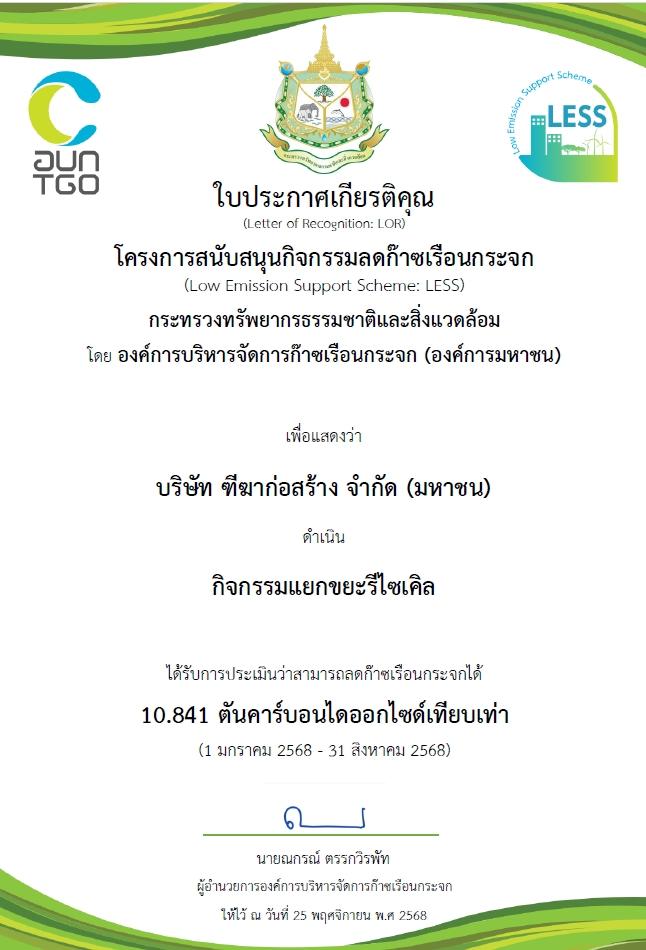
In 2025, the company received a certificate of honor for the Low Emission Support Scheme (LESS) from the Ministry of Natural Resources and Environment, awarded by the Thailand Greenhouse Gas Management Organization (Public Organization), for its waste separation for recycling activities. This project aims to encourage organizations to separate waste for recycling as much as possible, thereby reducing carbon emissions from new production processes. This award reflects the company's seriousness and dedication to environmental protection.
-
The company replaced two end-of-life gasoline vehicles with two electric vehicles and two plug-in hybrid vehicles.
-
The company arranged for a carbon footprint consultant to educate its personnel on carbon footprint knowledge and understanding.
Policies & Guidelines Changed
| Change |
|---|
| Electricity Management |
| Fuel Management |
| Renewable/Clean Energy Management |
| Water Management |
| Waste Management |
| Greenhouse Gas and Climate Change Management |
Energy — Plan & Guidelines
Has an Energy Management Plan
Yes
Plan Description
Issues regarding efficient resource utilization : The Company recognizes the importance of environmental impacts and the potential for resource scarcity in the future. Therefore, the Company aims to utilize resources most efficiently to minimize environmental impact. Currently, the Company reduces electricity consumption by using standard electrical equipment and machinery, and by installing automatic on-off sensors in walkways that activate when people pass through. Large machinery is regularly inspected by external engineers to ensure energy efficiency and extended lifespan. The Company also aims to replace end-of-life vehicles from internal combustion engines with electric vehicles.
Energy — Electricity Consumption
Electricity Consumption
| Metric | Current Year | Previous Year | Two Years Ago |
|---|---|---|---|
| Total electricity consumption within the organization (Kilowatt-Hours) | 146,641 | 134,143 | 115,308 |
| Electricity purchased for consumption from non-renewable energy sources (Kilowatt-Hours) | |||
| Electricity purchased or generated for consumption from renewable energy sources (Kilowatt-Hours) |
Energy — Fuel Consumption
Fuel Consumption
| Metric | Current Year | Previous Year | Two Years Ago |
|---|---|---|---|
| Crude oil (Barrels) | |||
| Coal (Metric tonnes) | |||
| Jet fuel (Litres) | |||
| Diesel (Litres) | 82,426 | 57,204 | 56,077 |
| Gasoline (Litres) | 9,587 | 13,521 | 12,793 |
| Fuel oil (Litres) | |||
| Natural gas (Standard cubic feet) | |||
| LPG (Kilograms) | |||
| Steam (Metric tonnes) |
Energy — Targets
Has Set Targets
No
Energy — Performance & Outcomes
Has Performance Results
Yes
Performance Description
The company collects energy consumption units by various types and presents them in the attached document.
Water — Plan & Guidelines
Has a Water Management Plan
No
Plan Description
Water Management: The company establishes water management plans in compliance with relevant laws, reducing water consumption and minimizing contact at various points by installing water-saving sensors on faucets. As the company operates in leased office space, it cannot ascertain the actual water consumption data. Therefore, the company calculates its water consumption by dividing the total building's water usage by the number of floors, then multiplying by the number of floors leased by the company. All water is subjected to 100% treatment of all wastewater before being discharged into the drainage system. In the construction of The Line project, the company implemented a water reduction project using Water Reuse innovation. This involves filtering used water with a self-made water filter constructed from materials available on the construction site. The filtered water is then reused for washing various tools and cleaning concrete pouring surfaces, which can save approximately 8,000 liters of water per week.
Water — Withdrawal, Discharge & Consumption
Water Withdrawal, Discharge & Consumption
| Metric | Current Year | Previous Year | Two Years Ago |
|---|---|---|---|
| Total water withdrawal (Cubic meters) | 4,389 | 4,056 | 4,394 |
| Total water withdrawal by third-party water (Cubic meters) | |||
| Total water withdrawal by surface water (Cubic meters) | |||
| Total water withdrawal by groundwater (Cubic meters) | |||
| Total water withdrawal by seawater (Cubic meters) | |||
| Total water withdrawal by produced water (Cubic meters) | |||
| Percentage of wastewater treated before discharge (%) | 100 | 100 | 100 |
| Total water discharge (Cubic meters) | |||
| Total water discharge to third-party water (Cubic meters) | |||
| Total water discharge to surface water (Cubic meters) | |||
| Total water discharge to groundwater (Cubic meters) | |||
| Total water discharge to seawater (Cubic meters) | |||
| Total water consumption (Cubic meters) | 4,389 | 4,056 | 4,394 |
| Recycled water (Cubic meters) |
Water — Targets
Has Set Targets
No
Water — Performance & Outcomes
Has Performance Results
Yes
Performance Description
The company collects water usage units and presents them in the attached document.
Waste — Plan & Guidelines
Has a Waste Management Plan
Yes
Plan Description
Waste Management Issues : The Company recognizes the importance of waste management as it helps reduce pollution generated from the Company's operations and minimizes the consumption of limited natural resources. The Company aims to dispose of waste in accordance with legal requirements and environmental impact assessment reports. Therefore, the Company begins by raising employee awareness of environmental conservation, starting with the efficient use of resources to minimize waste generation. This includes using only what is necessary or reducing consumption (reduce), reusing, and recycling. Furthermore, waste segregation is implemented for proper management. For instance, paper waste is sold to paper recycling plants. Waste from construction sites is destroyed or reused to maximize resource circulation efficiency. Remaining waste is reported by Company personnel to relevant agencies for proper collection and disposal. Electronic waste, which is non-biodegradable and can release toxins into the environment, can significantly impact ecosystems and food chains.
In 2023, the Company joined the E-Waste+ project, operated by Advanced Info Service Public Company Limited (AIS). The E-Waste+ project aims to properly dispose of electronic waste to prevent toxins from entering nature and to allow certain chemicals to be re-introduced into new production processes, thereby ensuring efficient resource utilization. The Company has placed AIS electronic waste collection boxes in the public relations lobby at the front of the head office building. The benefits derived from this project will ensure the proper disposal of electronic waste.
In 2024, employee training on proper waste segregation commenced and has been incorporated as a module in new employee orientation programs starting from 2024 onwards.
In 2025, a comprehensive recycling company was engaged to collect segregated waste for proper recycling and disposal. In 2025, the Company received an honorary certificate for the Low Emission Support Scheme (LESS) project from the Ministry of Natural Resources and Environment, administered by the Thailand Greenhouse Gas Management Organization (Public Organization), for its recycled waste segregation activities. This project aims to encourage organizations to segregate as much waste as possible for recycling, thereby reducing carbon emissions from new production processes. This award reflects the Company's seriousness and dedication to environmental efforts.
In 2025, the amount of waste available for recycling is as follows:
1. Head Office: 3,446 kilograms
2. Chuw Ratchathewi Project: 42,724.40 kilograms
3. Reference Ekkamai Project: 5,257.60 kilograms
remark that the table attached to this one report shows waste data specifically for the Head Office only.
Waste — Generation, Disposal & Recycling
Waste Generation — Introduction
This information is for headquarters only.
Waste Generation, Disposal & Recycling
| Metric | Current Year | Previous Year | Two Years Ago | Remark |
|---|---|---|---|---|
| Total waste generated (Kilograms) | 3,459 | 1,110 | 4,283.5 | |
| Non-hazardous waste (Kilograms) | 3,446 | 1,095 | 4,264 | Waste volume in 2024 decreased because wet waste was not weighed. By 2025, the company will utilize recycling services to collect waste directly from recycling plants. |
| Non-hazardous waste - Landfilling (Kilograms) | ||||
| Non-hazardous waste - Incineration (with energy recovery) (Kilograms) | ||||
| Non-hazardous waste - Incineration (without energy recovery) (Kilograms) | ||||
| Non-hazardous waste - Other disposal operations (Kilograms) | ||||
| Hazardous waste (Kilograms) | 13 | 15 | 19.5 | |
| Hazardous waste - Landfilling (Kilograms) | ||||
| Hazardous waste - Incineration (with energy recovery) (Kilograms) | ||||
| Hazardous waste - Incineration (without energy recovery) (Kilograms) | ||||
| Hazardous waste - Other disposal operations (Kilograms) | ||||
| Total reused/recycled waste (Kilograms) | 3,459 | 1,110 | ||
| Reused/Recycled non-hazardous waste (Kilograms) | 3,446 | 1,095 | ||
| Reused non-hazardous waste (Kilograms) | 0 | |||
| Recycled non-hazardous waste (Kilograms) | 3,446 | 1,095 | ||
| Reused/Recycled hazardous waste (Kilograms) | 13 | 15 | ||
| Reused hazardous waste (Kilograms) | 0 | |||
| Recycled hazardous waste (Kilograms) | 13 | 15 |
Waste — Targets
Has Set Targets
No
Waste — Performance & Outcomes
Has Performance Results
Yes
Performance Description
Headquarters separates waste and weighs it according to various types, as proposed in the attached document.
GHG — Plan & Guidelines
Has a GHG Management Plan
Yes
Plan Description
Climate Change Management Issues : The company recognizes the increasing severity of climate change, which impacts the environment and operations across all industries. Reducing global warming requires the cooperation of all sectors. Therefore, the company has joined as part of the efforts to mitigate the severity of global warming. In 2023, the company began studying methods for collecting various energy consumption data and waste disposal.
With the goal that in 2024, the company will collect energy consumption data for its head office premises within Scope 1 and Scope 2, and then calculate the amount of greenhouse gas emissions. Once the company knows the amount of greenhouse gas emissions, it will be able to plan future greenhouse gas management initiatives and projects. The calculation of the company's greenhouse gas emissions adheres to the principles of carbon footprint assessment by the Thailand Greenhouse Gas Management Organization (Public Organization), and the scope of reporting for this climate change management topic covers only the company's head office premises. In 2024, the company was able to operate according to the set goals.
In 2025, the company plans to arrange for consultants to educate employees on energy consumption data collection and management to reduce greenhouse gas emissions. In 2025, the company expects to achieve its set goals.
GHG — Emissions
GHG Emissions
| Metric | Current Year | Previous Year | Two Years Ago |
|---|---|---|---|
| Total GHG emissions (Metric tonnes of carbon dioxide equivalent) | 320.97 | 254.54 | 240.39 |
| Total greenhouse gas emissions 1 (Metric tonnes of carbon dioxide equivalent) | 247.67 | 187.49 | 182.75 |
| Total greenhouse gas emissions 2 (Metric tonnes of carbon dioxide equivalent) | 73.3 | 67.05 | 57.64 |
| Total greenhouse gas emissions 3 (Metric tonnes of carbon dioxide equivalent) |
GHG — Emissions Verification
Emissions Verified by a Third Party
No
GHG — Principles & Standards
Principles & Standards Applied
| Standard |
|---|
| 2671 |
GHG — Targets
Has Set GHG Targets
No
GHG — Performance & Outcomes
Has Performance Results
No
Environmental Legal Incidents
Legal Violation Incidents
| Metric | Current Year | Previous Year | Two Years Ago |
|---|---|---|---|
| Number of cases or incidents of legal violations or negative environmental impact (cases) | 0 | 0 | 0 |
Employees — Plan & Guidelines
Has an Employee Management Plan
Yes
Plan Description
Human Resource Management and Fair Labor Practices: To enhance the potential for business growth and competitiveness within the industry, the Company has implemented an efficient human resource management system to ensure it can attract and retain skilled employees. The Company has a workforce allocation plan to support annual growth and a recruitment process that selects individuals with the knowledge, abilities, and qualifications required for each position, adhering to human rights principles without discrimination based on gender, gender identity, race, religion, or culture. Consequently, the Company has a diverse workforce in terms of age, gender, gender identity, education level, and work characteristics. Furthermore, the Company provides opportunities for internal personnel to change positions or transfer roles when they meet the qualifications for available positions at that time. The Company advertises job openings through online channels such as various job application websites and Facebook: Teka construction.
Compensation : The Company prioritizes fair compensation and benefits for its personnel. The Company sets employee compensation at a level comparable to leading businesses in the same industry, referencing salary surveys from reputable external human resource management organizations. The Company uses these salary surveys as fundamental data for considering various compensation and benefits, alongside evaluating the abilities of each employee, without discrimination. This approach enables the Company to retain talented individuals and attract new, high-potential employees to join the organization.
The Company aims to treat its workforce in accordance with relevant laws (policies and practices regarding employment, including compensation, are specified in Part 2, Corporate Governance, Clause 7.4.2 on Policies and Practices regarding Employment and Compensation for Executives and Employees).
Number of employees by department as of December 31 | ||||||
2023 | 2024 | 2025 | ||||
Permanent Employees | Temporary Employees | Permanent Employees | Temporary Employees | Permanent Employees | Temporary Employees | |
Construction Department | 156 | 710 | 163 | 754 | 158 | 942 |
Construction Support Department | 49 | - | 38 | - | 40 | - |
Engineering and Quality Assurance Department | 52 | - | 47 | - | 57 | - |
Management Department | 23 | - | 25 | - | 28 | - |
Finance Department | 21 | - | 22 | - | 21 | - |
Procurement Department | 11 | - | ||||
Office of the Chief Executive Officer | 5 | - | 5 | - | 7 | - |
Total | 306 | 710 | 300 | 754 | 322 | 942 |
*In 2025, there will be a restructuring, separating procurement and contracting functions from construction support.
Employee Development: The Company recognizes that personnel are valuable resources and a crucial force in driving the organization's success. Therefore, the Company has a policy to develop the knowledge, abilities, and necessary skills for performing current and future roles to support organizational growth. The Company organizes seminars and training sessions led by knowledgeable and capable instructors, offering both online and onsite formats. There are specialized training programs for employees tailored to their job positions, management training courses for executives, and new employee training programs covering safety in using construction machinery, occupational health and environmental safety at work, quality policy according to ISO 9001-2015 requirements, personal data protection, work strategies, good corporate governance, business ethics and conduct, insider trading, anti-corruption, and whistleblowing channels. Additionally, other training programs are provided to develop various employee potentials suitable for their job characteristics. The benefits the Company gains from employee development include having quality human resources, and employees applying their acquired knowledge to enhance work efficiency, leading to the Company's sustainable growth. The Company aims to collect and disclose employee training hours as required by law. Furthermore, the Company has a succession plan for executives from the director level upwards, where the qualifications for each position depend on experience, expertise, and other skills, without considering gender, gender identity, religion, or age in the selection process.
To ensure the company's continuous business operations, the company has established a policy for the recruitment of key successors, from the director level upwards. For C-level positions, the Nomination and Remuneration Committee will participate in the selection process. Additionally, a Succession Plan and employee development plans have been established. The company primarily structures its succession planning by recruiting internal employees, with the condition that individuals to be promoted must train their team members to perform their current duties before they can advance to a higher position. To foster continuous self-development, the company selects individuals based primarily on their abilities, not on seniority or length of service. Furthermore, management is responsible for updating the Nomination and Remuneration Committee twice a year on the progress of the succession development plan for successors from the director level upwards.
Human Rights Respect: The Company understands and values diversity in terms of gender, gender identity, age, nationality, race, religion, culture, education, physical appearance, etc. Therefore, the Company emphasizes respect for human rights. In 2023, the Company established a Human Rights Policy to serve as a guideline for its personnel and relevant stakeholders to ensure equal and non-discriminatory coexistence. Additionally, the Company encourages employees to strictly adhere to human rights principles towards stakeholders, such as promoting diversity of opinions and providing channels for complaints. Shareholders can review the full Human Rights Policy at: https://investor.tekacon.com/th/corporate-governance/corporate-governance-policy
Plan Areas
| Plan Area |
|---|
| Fair employee compensation |
| Employee training and development |
| Promoting employee relations and participation |
| Migrant/foreign labor |
| Child labor |
| Occupational health and safety in workplace |
Employees — Workforce
Workforce Data
| Metric | Current Year | Previous Year | Two Years Ago |
|---|---|---|---|
| Total number of employees (Persons) | 322 | 318 | 311 |
| Number of male employees (Persons) | 183 | 185 | 185 |
| Number of female employees (Persons) | 139 | 133 | 126 |
| Total employment of disabled persons (people) | 0 | 0 | 0 |
| Total disabled employees (people) | |||
| Total male disabled employees (people) | |||
| Total female disabled employees (people) | |||
| Total disabled workers who are non-employee (people) | |||
| Contributions to the fund for promoting and improving the quality of life for disabled persons | 1 | 1 | 1 |
| Total number of male employees in operational level (Persons) | 142 | 148 | 147 |
| Total number of male employees in management level (Persons) | 37 | 33 | 34 |
| Total number of male employees in executive level (Persons) | 4 | 4 | 4 |
| Total number of female employees in operational level (Persons) | 116 | 119 | 114 |
| Total number of female employees in management level (Persons) | 22 | 13 | 11 |
| Total number of female employees in executive level (Persons) | 1 | 1 | 1 |
Employees — Remuneration & Provident Fund
Remuneration & Provident Fund
| Metric | Current Year | Previous Year | Two Years Ago |
|---|---|---|---|
| Total disabled employees (people) | 274,860,000 | 275,440,000 | 263,770,000 |
| Total male employee remuneration (Baht) | |||
| Total female employee remuneration (Baht) | |||
| Number of employees eligible to participate in PVD (persons) | 322 | 318 | 311 |
| Total number of employees joining employee provident fund (Persons) | 175 | 171 | 151 |
| Percentage of total number of employees joining employee provident fund to total number of employees (%) | 54.35 | 53.77 | 48.55 |
| Number of PVD members / Total eligible employees (%) | 54.35 | 53.77 | 48.55 |
| Total amount of provident fund contributed by the Company (Baht) | |||
| Total amount of provident fund contributed by employee (baht) |
Employees — Training & Development
Training Data
| Metric | Current Year | Previous Year | Two Years Ago |
|---|---|---|---|
| Average employee training hours (Hours / Person / Year) | 25.36 | 10.46 | 10.25 |
| Employee development and training expenses (baht) | 712,757.37 | 723,916.57 | 674,061.69 |
Employees — Occupational Health & Safety
Occupational Health & Safety Data
| Metric | Current Year | Previous Year | Two Years Ago |
|---|---|---|---|
| Total number of lost time injury incidents by employees (Cases) | 0 | 0 | 0 |
Employees — Labour Relations
Labour Relations Data
| Metric | Current Year | Previous Year | Two Years Ago |
|---|---|---|---|
| Total voluntary resignations (Persons) | 47 | 38 | 76 |
| Male employees who voluntary resigned (Persons) | |||
| Female employees who voluntary resigned (Persons) | |||
| Percentage of employee turnover leaving the Company voluntarily (%) | 14.6 | 11.95 | 24.44 |
| Evaluation result of employee engagement |
Employees — Employee Representation
Employees Are Represented Collectively
Yes
Forms of Representation
| Form |
|---|
| Welfare committee |
Employees — Targets
Has Set Employee Targets
No
Employees — Performance & Outcomes
Has Performance Results
Yes
Performance Description
The company has engagement-building projects and various activities related to employee safety, which are described in section 7.4.
Customers — Plan & Guidelines
Has a Customer Management Plan
Yes
Plan Description
As the company views customer satisfaction management as one of the dimensions of corporate governance, it has already been explained under the topic of corporate governance.
Plan Areas
| Plan Area |
|---|
| Responsible production and services for customers |
| Communication of product and service impacts to customers/consumers |
| Development of customer satisfaction and customer relationship |
| Protection of customer personal information |
Customers — Satisfaction Results
Customer Satisfaction Results
| Metric | Current Year | Previous Year | Two Years Ago |
|---|---|---|---|
| Evaluation results of customer satisfaction | 1 | 1 | 1 |
Customers — Targets
Has Set Customer Targets
No
Customers — Performance & Outcomes
Has Performance Results
Yes
Performance Description
The company implements quality management and maintains relationships to ensure utmost customer satisfaction, as described in the governance dimension of sustainability management.
Community & Social — Plan & Guidelines
Has a Community & Social Plan
Yes
Plan Description
Issues of Coexistence with the Community: The company operates its business with a commitment to being an organization that coexists with communities and society in a high-quality manner, especially with communities surrounding construction sites. The company prioritizes the safety and quality of life of these communities, thus emphasizing standardized work processes to ensure that communities can be confident that their daily lives will not be adversely affected. In addition to managing construction impacts, the company also focuses on building good relationships with surrounding communities through various activities to foster positive camaraderie and enhance its image. The company aims to improve the efficiency of its complaint recording system from communities by developing systems and channels for receiving complaints and reporting results, enabling effective analysis of various data, including financial figures, and leading to continuous improvements.
The company has an operational plan for social activities around construction sites, aiming to prevent damage, maintain, and enhance the positive image of the company, project owners, and project consultants. Furthermore, the company conducts activities that benefit society through Corporate Social Responsibility (CSR) initiatives. The company employs a 4Cs strategy for community relations, covering both in-process and after-process operations: Collaboration, Commitment, Consistency, and Communications. It also has proactive and reactive work plans based on the principles of understanding, accessibility, and development, implemented through various company projects designed to assist communities and build strong community relationships, such as the Homecare project and the Teka Care project, which will be carried out concurrently with the respective construction projects.
The 'Homecare: Livable Community' project aims to engage workers and employees of construction projects for which the company is responsible in assisting or facilitating communities in basic aspects of daily life not resulting from construction impacts. Assistance will be based on community needs, such as safety, the surrounding environment, and housing maintenance. The company conducts weekly site visits to meet with communities, discuss and communicate work plans, and ascertain community assistance requirements.
The 'Teka Care: Jointly Caring and Attentive' project aims to foster cooperation in various community activities, either at the community's request for support or as initiatives the company intends to support, recognizing their benefit to the community, with at least 3 activities per year. Examples include installing solar panels to enhance lighting in walkways and providing fire extinguishers to the community.
Additionally, the company has had the 'Build for Kids: Palang Teekha, Building Dreams, Sharing Love' project since 2022, aiming to support education by renovating and delivering container libraries to schools lacking funds to provide libraries for students. The company's concept involves reusing discarded items from its operational processes for beneficial purposes, such as repurposing shipping containers used as site offices in construction projects into libraries for students. However, due to limitations in transporting container libraries, the company initially launched the project in the Bangkok metropolitan area during its early stages.
Plan Areas
| Plan Area | Other — Please Specify |
|---|---|
| Employment and professional skill development | |
| Education | |
| Forests and natural resources | |
| Disadvantaged and vulnerable groups | |
| Others | Coexistence with the Community |
Community & Social — Targets
Has Set Community & Social Targets
No
Community & Social — Performance & Outcomes
Has Performance Results
Yes
Performance Description
Social and Community Performance in 2568
-
The Home Care project and Teka Care project can effectively promote and build good relationships between construction projects and surrounding communities, thanks to a dedicated team that continuously visits sites and implements the 4 C strategy.
-
supported funds for prizes to be given to children and youth in Soi Surao (Phetchaburi 7) community on National Children's Day 2568 which is a neighboring community in the project construction area Shush Ratchathewi
-
supported the cost of food and beverages for those breaking their fast throughout Ramadan, the month of
fasting in the Hijri year 1446 ( 1 - 30 March 2568) to Darul Aman Mosque, Phaya Thai, which is in a neighboring community in the project construction area Shush Ratchathewi -
supported merit-making and alms-giving activities for the elderly in the Soi Daeng Buhnga community, Thung Phaya Thai Subdistrict, Ratchathewi District, Bangkok, which is a neighboring community in the project construction area Shush Ratchathewi
-
provided scholarships to engineering students at Chiang Mai University under the "Fulfilling Dreams, Building Engineers" project of the Alumni Association of the Faculty of Engineering, Chiang Mai University, totaling 2 Funding
-
donated a container library to Wat Khon Hom School, Tan Diao Subdistrict, Kaeng Khoi District, Saraburi Province achieved the target
-
supported the employment of intellectually disabled persons The Foundation for the Welfare of the Mentally Retarded of Thailand under Royal Patronage by contributing funds as required by law
-
supported the organization of the Phaya Thai Samphan Unity event for the year 2568 which is a neighboring community in the project construction area Shush Ratchathewi
-
supported the organization of World Diabetes Day activities ( World Diabetes Day) of Wat Salut Sub-district Health Promoting Hospital, Bang Kaeo Subdistrict, Bang Phli District, Samut Prakan Province which is a neighboring community in the project construction area Raffles American School
-
organized beneficial activities to make the world a better place, under the name "Mangrove Planting: Conserving Forests, Replenishing Ozone for the World" at the Bang Pu Army Nature Education Center to help restore coastal ecosystems and bring back the lushness of nature.
-
contributed aid and encouragement by donating dried food and essential consumer goods to alleviate the suffering of flood victims in the southern region, through the Royal Thai Air Force Disaster Relief Center
-
provided financial support for the organization of a volunteer development and public service camp through the Volunteer Development and Public Service Club of the Faculty of Engineering Student Union, Chiang Mai University, to support the construction of a multi-purpose area, expansion of the kindergarten cafeteria, and landscape improvement at Kamon-Riam Sukosol School
(Ban Pha Tai) Tha Ton Subdistrict, Mae Ai District, Chiang Mai Province
Law Violation Incidents
Law Violation Incidents
| Metric | Current Year | Previous Year | Two Years Ago |
|---|---|---|---|
| The total number of cases or incidents of significant violations of laws or regulations regarding social and human rights (Cases) | 0 | 0 | 0 |
| The total number of cases or incidents that cause significant labor disputes (Cases) | 0 | 0 | 0 |
| The total number of cases or complaints related to consumer rights violations (Cases) | |||
| The total number of cases or complaints related to partner rights violations (Cases) | |||
| The total number of cases or incidents that cause disputes with the community/society (Cases) | |||
| The total number of cases or incidents related to cyber security or customer data breaches (Cases) | |||
| The total number of cases or incidents related to safety and occupational health at work (Cases) |