

Risk Management · 2025
In this section3 topics
Risk Management Policy & Plan
Policy & Plan Description
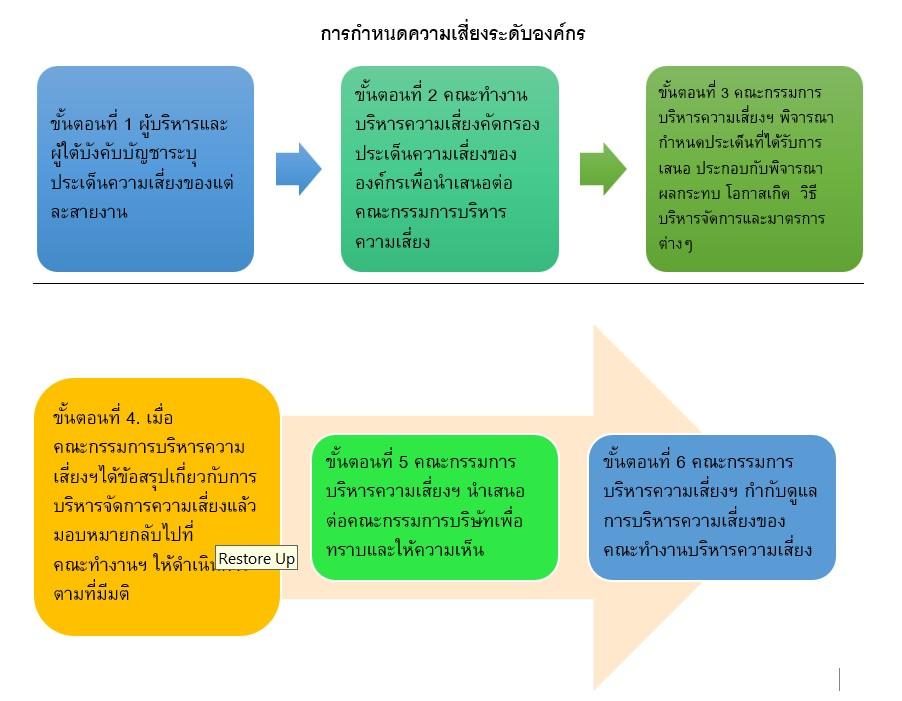
The company recognizes the importance of risk management, which is an integral part of good corporate governance and a fundamental element that helps the company achieve its objectives and mitigate the impact of significant events that may affect shareholders. Therefore, the Board of Directors has established a risk management policy and structured the risk management framework to enable timely risk management. The risk management policy and guidelines are summarized as follows:
The company stipulates that risk management is the responsibility of employees at all levels, who must be aware of the risks inherent in their work. Executives must communicate to employees that risks are part of everyone's daily life and every work process. All employees are responsible for identifying and assessing risks related to their work, as well as defining appropriate measures to manage these risks. Furthermore, supervisors must raise awareness among their subordinates to exercise caution. If an employee perceives a risk that is about to exceed their management capacity, they must inform their superior in accordance with the hierarchical structure and severity level, so that the superior can participate in resolving the risk to keep it within an acceptable level. Both executives and employees must establish guidelines for preventing and mitigating risks from the company's operations to avoid potential damage or losses, as well as regularly monitor and evaluate risk management performance.
The company has adequate and appropriate quality processes, guidelines, and measures for risk management and impact mitigation, which comply with international standards. The risk management system has been integrated into the company's decision-making, strategic planning, operational plans, and operations. This includes continuous and consistent identification, analysis, assessment, prioritization, management, control, monitoring, reporting, evaluation, and communication of risk information throughout the company.
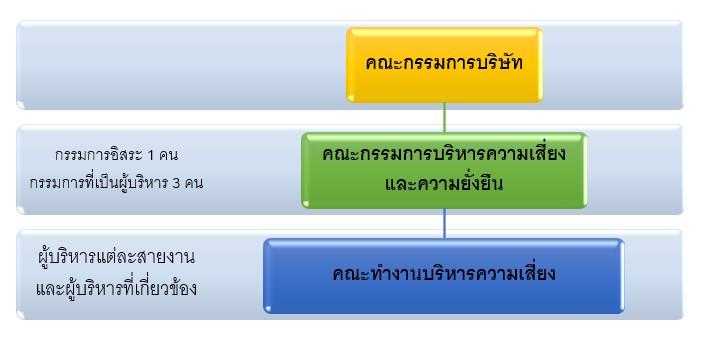
In 2025, the Risk and Sustainability Management Committee, comprising 1 independent director and 3 executive directors, is responsible for establishing the operational framework, the enterprise-level risk management plan, and for reviewing, monitoring, and assessing risks that impact the achievement of the company's vision, objectives, goals, or operational strategies. This also includes identifying measures to keep risks at an acceptable level. Details of the Risk Management Committee's operations are described in the section on the Report of the Risk and Sustainability Management Committee (Attached Document).
To ensure timely risk management, the Risk Management Committee has appointed a Risk Management Working Group, comprising the top four executives, the Construction Director, and relevant executives, to implement various measures and oversee risks promptly. The Risk Management Working Group holds progress monitoring meetings 6 times per year. The full risk management policy is disclosed on the company's website.
 .
Policy Document Link
https://investor.tekacon.com/storage/document/cg/risk-management-policy-en.pdf
Page Number in Report
2-3
Risks to the Company's Business Operations
Introduction
The Risk and Sustainability Management Committee has identified 7 types of risk factors that may affect the company's business operations, namely:
-
Strategic Risk
-
Operational Risk
-
Financial Risk
-
Information Technology Risk
-
Management Risk
-
Compliance Risk
-
Sustainability Risk (ESG)
Risk Register
| Risk Name | Risk Characteristics | Consequences | Management Measures | Related Risk Factors |
|---|---|---|---|---|
| 1. Strategic Risk 2. Operational Risk (covering social, community, and environmental risks, and corporate governance) 3. Financial Risk 4. Information Technology Risk 5. Management Risk 6. Compliance Risk 7. ESG Sustainability Risk | Risk Factors for the Company's Business Operations The Risk and Sustainability Management Committee has identified seven types of risk factors that may impact the company's business operations: 1. Strategic Risks, 2. Operational Risks, 3. Financial Risks, 4. Information Technology Risks, 5. Management Risks, 6. Legal Compliance Risks, and 7. ESG Sustainability Risks. Details are as follows: 1. Strategic Risks : As there are numerous contractors, both large and small, in the market, price competition is intense. Increased competition may expose the company to risks regarding revenue continuity, affecting both short-term and long-term goals, and potentially leading to a reduction in project profit margins. Risk Management : As large-scale building construction projects compete on work quality and timely delivery, the company employs a strategy of quality and timeliness, which are considered its strengths in building client confidence. This advantage has led some former clients to invite the company to bid on new projects. Furthermore, in some projects, clients choose the company as the contractor even when it is not the lowest bidder, reflecting that clients consider not only price but also other factors such as construction quality and punctuality. However, price remains a significant factor for clients. Therefore, to enable the company to compete with other rivals, it manages this risk by continuously focusing on maintaining and developing quality, as well as the cost estimation process, and has a policy to ensure accurate, complete, and precise cost estimates to offer appropriate and competitive construction prices. Additionally, management sets annual work plans, which inform the company when projects will gradually be delivered. The company also promotes its past large-scale building construction achievements, such as hotels, factories, hospitals, and educational institutions, alongside surveying the condominium market and other construction types to seek new projects and participate in various bidding processes to ensure a consistent volume of construction work. 2. Operational Risks : 2.1 Risks from Delays In the construction contracting business, timeliness and quality of work are key factors that both contractors and clients prioritize. Construction contracts typically specify conditions regarding the time and quality of construction work, such as the schedule for the contractor to complete the construction, the schedule and conditions for payment of wages, and the quality of work to be delivered. If the company cannot proceed according to the established construction plan, various impacts may arise, such as increased costs, damage to credibility, and potential penalties for late delivery of work. Risk Management : The company has a policy to establish appropriate and feasible construction plans. Regular internal project meetings are held to monitor progress and construction issues, and reports are submitted to management weekly. This ensures that management is aware of the project's status and can manage various matters within appropriate timelines. The primary reason for construction delays is often changes in designs by the client, which leads to extensions of the project duration for the company. 2.2 Risks from Actual Construction Costs Exceeding Project Budget Generally, construction contracts specify a fixed project value. In cases where costs increase, it directly impacts profit margins, including rising material prices. Clients and contractors typically define the scope of work and agree on prices in advance. Therefore, accurate cost estimation and cost control in line with estimates are crucial factors for construction contractors, as discrepancies in cost estimates directly affect project profitability. Risk Management : As a contractor, the company must rely on experience and accurate cost estimation capabilities to set appropriate prices and reduce potential risks. The company is well aware of this risk and therefore has a policy to immediately order or reserve important construction materials in advance upon receiving a contract, especially rebar, which experiences significant price fluctuations compared to other construction materials. Additionally, the company regularly monitors construction material prices to assess trends for appropriate material procurement planning. Oversight begins with the company's material procurement process, which involves creating a vendor list and purchasing from approved vendors on this list, comparing prices and product quality to obtain quality construction materials at reasonable prices. Furthermore, some construction contracts with real estate developers stipulate that the developer bears the risk of fluctuating material costs. Throughout the past, the company has emphasized the cost estimation process and has a policy to ensure that cost estimates are accurate, complete, and precise. The company has a Cost Estimation and Marketing Department with a team of personnel who possess expertise and experience in quantity surveying and cost estimation. This team meticulously prepares BOQ (Bill of Quantity) to determine the required material quantities and specifications, and researches material and labor costs to ascertain the material and labor expenses for cost estimation. Moreover, during the quantity surveying and cost estimation process, there is continuous coordination with project owners and project consultants to clarify details and minimize any uncertainties for the company, enabling accurate quantity surveying and cost estimation. After the quantity surveying team has completed the quantity surveying and cost estimation, there is a verification process for the accuracy of the quantity surveying and cost estimation. The Manager of the Cost Estimation and Marketing Department and the assigned Project Director will review the results of the quantity surveying and cost estimation again. Once a project is awarded, the company oversees the utilization of the allocated budget, ensuring that each disbursement is supported by a budget and that expenditures do not exceed the budget. 2.3 Risks related to accidents, safety, and environment within and around construction sites : Due to the nature of building construction processes, there may be impacts on nearby areas, concerning safety, occupational health, social communities, and the environment. Examples include potential construction accidents, noise pollution, dust pollution, and land subsidence in adjacent areas due to excavation or foundation construction. Such impacts could lead to complaints or lawsuits against the company from affected parties and may damage the company's reputation and credibility. Risk Management : To mitigate the risk of accidents that may affect the project and surrounding areas, the company has prepared a safety manual and regulations for construction sites for relevant personnel. Training is provided to raise awareness among employees and subcontractors regarding safety, with the number of training sessions exceeding legal requirements. Furthermore, safety officers at all levels must ensure that employees comply with the company's safety rules. Supervisors of each unit are responsible for overseeing and randomly checking that employees adhere to both the operational manual and the safety manual. Any non-compliance with safety manuals and procedures will result in immediate disciplinary action. In terms of environmental aspects, the company prioritizes environmental impact by complying with environmental impact assessments approved by the Office of Natural Resources and Environmental Policy and Planning, and aims to minimize various impacts as much as possible. To reduce potential risks, the company has implemented various preventive measures, such as using nets and spraying water to prevent dust from escaping into adjacent areas, and conducting certain types of construction that may cause noise pollution only during daytime hours. Additionally, the company has assigned community relations officers to visit sites to listen to feedback from communities around the construction areas, in order to seriously address any issues. 3. Financial Risks : As the construction contracting business utilizes funds received from clients, whether advance payments or progress payments (typically paid upon completion milestones), for purchasing construction materials or hiring subcontractors. If the company is unable to collect payments from clients within the stipulated timeframe, which may occur due to construction not meeting targets or delayed payments from clients, it will affect the company's working capital. Should the company face working capital issues, it could impact its bargaining power with suppliers for construction materials, its bargaining power with subcontractors, and its opportunities to bid on new projects. Such risks could significantly affect the company's business operations, financial position, and performance. Risk Management : The company mitigates the risk of insufficient working capital by planning the utilization of funds for each project phase in alignment with the construction schedule, enabling accurate financial forecasting. Oversight ensures that construction proceeds according to schedule to allow for timely payment collection. Furthermore, the company studies the payment history of various real estate developers before undertaking construction projects to reduce the risk of non-collection or delayed collection of payments from clients. Currently, the company maintains a very strong cash flow. 4. Information Technology Risks : As the company increasingly utilizes information technology systems in its operations, from storing and processing commercial data to employees' personal data, there are risks associated with servers, computer systems, and networks, risks from software copyright infringement, and risks from various cyber threats such as cyber theft, data destruction, data loss, or data leakage. Risk Management : The company has implemented a Business Continuity Plan (BCP) and data backup for emergency data recovery. It has systems to prevent theft, and access rights to information are restricted to relevant personnel only. Additionally, the company maintains internet usage logs for retrospective access verification. Employees are required to change their passwords every 90 days. The company provides continuously updated antivirus systems and firewalls. Settings are configured to prevent employees from installing any software on their computers, and there are periodic plans for checking various security measures. 5. Management Risks : As construction contracting is a specialized service requiring the expertise of knowledgeable and understanding executives, with the current management structure, the company still faces the risk of over-reliance on key executives, namely the major shareholders, and lacks successors for important positions. Risk Management : To ensure continuous business management, the company has established a policy for recruiting successors for important positions, from director level upwards. For C-level positions, the Nomination and Remuneration Committee participates in the selection process. Additionally, succession plans and employee development plans are in place. The company primarily structures succession planning through internal recruitment, stipulating that individuals eligible for promotion must first train their team members to perform their current duties before being promoted to a higher position. To foster continuous self-development, the company selects individuals based primarily on their abilities, not on seniority or length of service. Furthermore, management is responsible for updating the Nomination and Remuneration Committee twice a year on the progress of succession development plans for positions from director level upwards. 6. Legal Compliance Risks : As the construction contracting business involves numerous laws, such as construction laws, labor laws, environmental laws, engineering professional laws, personal data protection laws, tax laws, and accounting standards. Furthermore, once the company's shares are traded on the stock exchange, the company is also obligated to comply with laws related to securities and the stock exchange. Risk Management : The company plans to manage risks related to compliance with various laws by assigning executives of each business unit to supervise their subordinate units to correctly comply with relevant laws, such as labor laws supervised by the Chief Administrative Officer, and laws related to construction or engineering professions supervised by the Chief Construction Officer and relevant executives. Regarding the new Personal Data Protection Act, the company raises awareness among all employees who can access personal data by organizing training on compliance with the Personal Data Protection Act, including the penalties for non-compliance. Furthermore, for sustainable management, the company provides training on ethics and integrity to encourage employees to be aware of good corporate governance, prevention of conflicts of interest, insider trading, and anti-corruption. If, ultimately, there is a violation of the law, the company has opened channels for stakeholders to report misconduct, along with measures to protect whistleblowers and processes for punishing offenders. 7. Sustainability Risks ( The company recognizes the importance of sustainable business operations and has therefore assessed sustainability risks across three dimensions: corporate governance and economic risks, environmental risks, and social and community risks, which may impact sustainable business operations. This assessment is used to plan risk management and respond to risks promptly. Risk Management : The company has established a sustainable business driving policy to serve as a guideline for its personnel to follow. The company places importance on adapting to rapidly changing policies, laws, markets, technology, and environmental conservation values. This includes promoting equal treatment in accordance with human rights principles for all stakeholders without discrimination based on gender, gender identity, race, religion, age, etc. To mitigate risks throughout the supply chain, the company expects its business partners to fully prioritize ESG (Environmental, Social, and Governance) in all dimensions. Therefore, the company has established a code of conduct for business partners to communicate to key partners throughout the supply chain that, as partners of the company, they must adhere to this code of conduct by having key partners sign an acknowledgment of the code of conduct for partners. 8. Other Risks Emerging risks in the next 3-5 years : After the COVID-19 pandemic, new epidemics have continuously emerged, such as Monkeypox, Tomato Flu, and other potential epidemics that could have severe impacts similar to COVID-19. There are also environmental impacts from PM2.5 dust, or ongoing conflicts like the Russia-Ukraine war and the Israel-Palestine war, which carry risks of escalation, affecting the global economy and potentially the Thai economy. Risk Management : The company has learned lessons from managing the COVID-19 pandemic, such as implementing preventive measures and proactive screening for workers in all projects, the 'Bubble and Seal' measures, and other necessary and appropriate measures for specific situations. The company has learned how to manage epidemics. Should another epidemic occur, the company has appropriate measures to ensure a safe working environment for employees. Furthermore, dust and pollution reduction are already part of the company's safety and occupational health management processes. Regarding the risk of war that may affect economic conditions, the Risk Management Committee and the Risk Management Working Group will closely monitor news to prepare for timely responses. | Described in the section on risk characteristics | As explained in the section on risk characteristics | 739 · Description: Shortage or reliance on skilled workers · Info category: OPERATIONAL_RISK · 740 · Description: Shortage or fluctuation in pricing of raw materials or productive resources · Info category: OPERATIONAL_RISK · 758 · Description: Violations of laws and regulations · Info category: COMPLIANCE_RISK · 742 · Description: Human error in business operations · Info category: OPERATIONAL_RISK · 1724 · Description: Liquidity risk · Info category: FINANCIAL_RISK · 749 · Description: Safety, occupational health, and working environment · Info category: OPERATIONAL_RISK · 737 · Other name: Price competition · Description: Other · Info category: STRATEGIC_RISK · 755 · Other name: Cost Calculation · Description: Other · Info category: OPERATIONAL_RISK |
Risks to Securities Holders' Investment
Risk Register
| Risk Name | Risk Characteristics | Consequences | Management Measures | Related Risk Factors |
|---|---|---|---|---|
| Shareholder Investment Risk | Risk from having a single major shareholder holding more than 25% of shares: This is because Vanich Holding Co., Ltd. is the major shareholder, holding 74% of the voting shares. The major shareholder can exercise the right to object to resolutions at shareholders' meetings on various matters, such as those legally requiring no less than three-fourths of the total votes of shareholders present and eligible to vote. (Details of the shareholding structure are in Section 1.1, regarding policies and overall business operations.) Risk Management : To ensure the company's business operations are transparent and to maintain a balance of power in the company's administration, the company has established a management structure comprising the Board of Directors, the Audit Committee, the Nomination and Remuneration Committee, and the Risk Management Committee. These committees consist of knowledgeable and capable personnel, with clearly defined scopes of operation and delegation of authority to the Board of Directors and its sub-committees. Furthermore, measures have been established for transactions involving major shareholders, controlling persons, directors, executives, and individuals who may have conflicts of interest. Additionally, four independent external individuals have been appointed to the Board of Directors, making a total of seven directors. Independent directors are assigned to sub-committees, and three audit committee members have been appointed to oversee and balance decision-making, as well as to consider and approve various items before presentation to the shareholders' meeting.
Risk Management: This is because share prices depend on stock market conditions, as well as the supply and demand of those wishing to hold shares at that time, which is beyond the company's control. Shareholders may not receive returns as expected. Regarding dividends, even if the company generates profits, if at that time the company has operational plans that require funds, dividends may not be paid, resulting in shareholders not receiving dividends as anticipated. However, the company has disclosed details regarding its operating results, along with quarterly analytical reports and management discussions, as well as various movements through the Stock Exchange's information disclosure system. To mitigate the risk of returns not meeting investor expectations, investors should study various information before making investment decisions. | Already explained under the heading "Characteristics of Investment Risk for Securities Holders." | As explained in the section on the nature of investment risks for security holders. | 2969 · Description: Risk of the company having a majority shareholder holding > 50% of shares · Info category: HOLDER_RISK |